Who is affected
Operations analysts need a prioritized queue. Managers need a clear view of volume and severity. Customers feel the consequence when an exception is noticed too late.
I designed this agent around the real work of reviewing delivery problems: I chose the signals, defined the evidence needed for a next step, and set the handoff rules for human review. It turns delayed or conflicting orders into a clear next step without taking consequential decisions away from people.
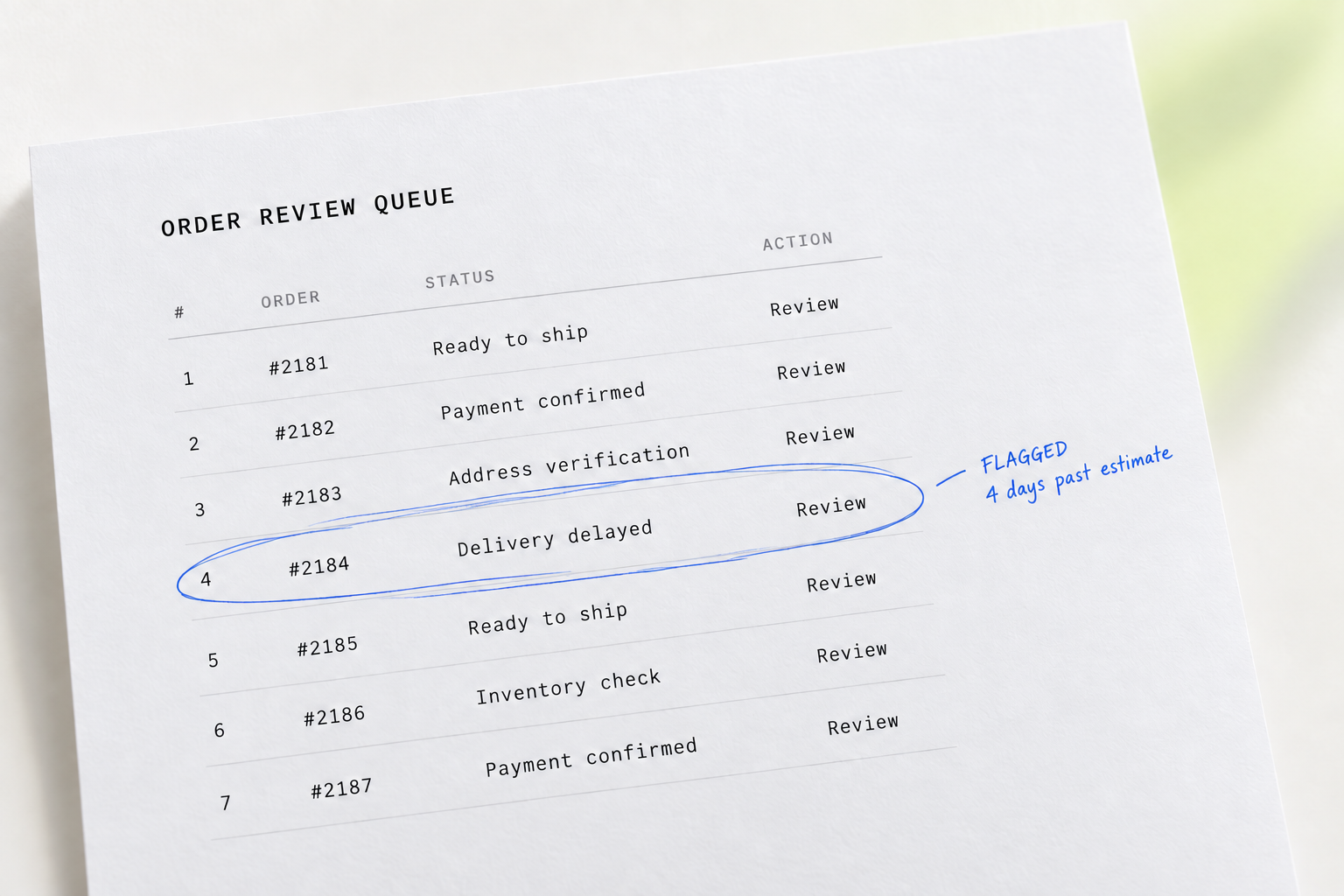
The source export remains unchanged. The agent applies four approved checks, gathers the available order context, proposes the next safe step, and routes risk or uncertainty to a person.
Prototype boundary: the dataset represents 200 Shopify-like synthetic orders. The prototype does not connect to carriers, send customer messages, issue refunds, or change an order. Those actions require approved integrations, policies, and human oversight.
A late fulfillment, missing stock, missed delivery date, or refund-shipment mismatch can be easy to miss in a large export. The operational cost is delayed attention, inconsistent triage, and a manager who cannot quickly see the work queue.
Operations analysts need a prioritized queue. Managers need a clear view of volume and severity. Customers feel the consequence when an exception is noticed too late.
Fulfillment delay, inventory mismatch, delivery delay, and refund-versus-shipment conflict are factual comparisons, not subjective AI judgments. Each follows a deterministic rule that is easier to test, explain, and audit.
Explaining why an issue happened, customer messaging, refunds, and inventory changes remained human decisions. The export can confirm a conflict, but not prove its operational cause.
The agent turns a signal into a bounded investigation. It checks the export, gathers the available evidence, proposes an approved next step, and hands over anything uncertain, sensitive, or financially consequential.
Keep source rows intact and confirm each signal has the fields it needs.
Look for fulfillment delay, inventory mismatch, delivery delay, and refund-versus-shipment conflict.
Assemble order status, tracking evidence, severity, and the reason the case was flagged.
Prepare a follow-up, monitoring, or review recommendation from approved rules and evidence.
Any uncertain, sensitive, or high-impact case goes to a person before action.
This prototype does not claim a time or cost saving. A production pilot would compare a defined manual baseline with the workflow, then monitor quality as volumes and exceptions change.
Time from exception to first review, open-queue age, exceptions processed per analyst, and avoidable customer contacts
Rule precision, false positives, missed exceptions, human override rate, and time to resolve an error
Named rule owners, access controls, run logs, alerts for failures, and a human fallback for every unsafe route
Measurement approach informed by the NIST AI RMF Measure guidance ↗, which recommends comparison with manual or human baselines and tracking error response.
| Observed in the prototype | What it demonstrates |
|---|---|
| 40 exceptions, 10 of each designed type | The rules ran consistently across the synthetic input |
| 38 cases routed to review | The safety boundary held for all but two strict low-risk cases |
| 6 recorded review decisions | The workbook captures decision, reason, reviewer label, and timestamp |